There are numerous ways to determine what type of plastic you have, but we've narrowed the list down to 5 different things you can do. They are:
- Use the recycling numbers listed on the plastic (the Resin Identification Code)
- Compare the use of your plastic with a list of common applications
- Float testing
- Bend/break testing
- Flame testing
More on each below:
- Use the Resin Identification Code (see Figure 1)
These are the numbers listed on plastic and it's the easiest way to tell what type of plastic you have. Once you see find the number, match it to the image above (Figure 1) to determine what type of plastic it is. Unfortunately, these are not always printed on the plastic so you will need other methods. That's where a good comparative list comes in.
- Use a list of common applications to determine your plastic
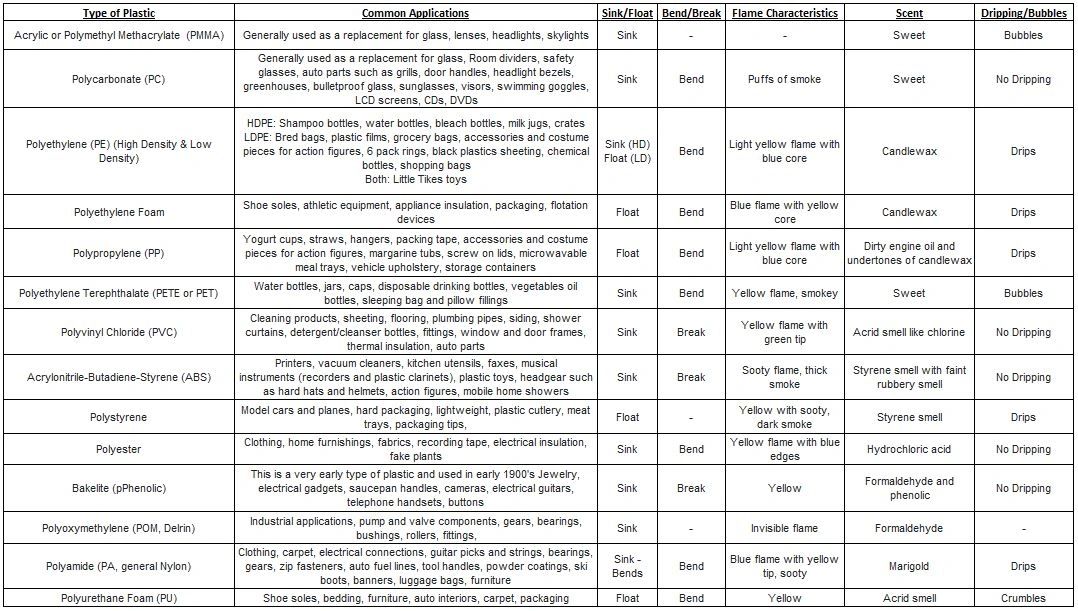
This is a simple process of comparing your plastic use to common applications. We've provided a list of common applications of some plastics which Retro-Briters may come across on our post entitled Common Applications of Various Plastics, or you can see it in Table 1 below.
If these two methods still don't meet your requirements, then there are three different types of tests you can conduct. We'll start with the least destructive.
- Float testing
Fill a bowl or basin full of water and place a test article in the water. Note if the plastic sinks or floats and compare the results to the table below (Table 1, below). While this is a simple test, it has its limits as it only groups various plastics into two categories. Nonetheless, you still get back some data which may help.
- Bend/break testing
Hold the test article between your two hands and slowly bend. Note if the test article breaks or bends and compare it to the list below (Table 1). As with the float test, this test is limited as it only groups various plastics into two categories. But again, it may provide some helpful data.
- Flame testing
Light a small test article of the plastic on fire with a lighter and note the flame characteristics (color and smoke), odor (via wafting), and if the plastic drips or bubbles. Compare your results to the table below (Table 1). (Note: While we don’t encourage you to do the flame test as it destroys your test article, here is a great video of how to conduct a flame test. If you do decide to conduct a flame test, please use proper safety precautions and PPE)
We hope that this information is helpful! If you have any suggestions or to add to our data set, please email us at support@www.retro-brite.com!
Here are some of the sources we used to make this article.
- https://tinyurl.com/28drsy9c
- https://tinyurl.com/58hc4c37
- https://tinyurl.com/ycm7mbuu
- https://tinyurl.com/2p85r7v7
- https://tinyurl.com/mryphjsy
0 comments